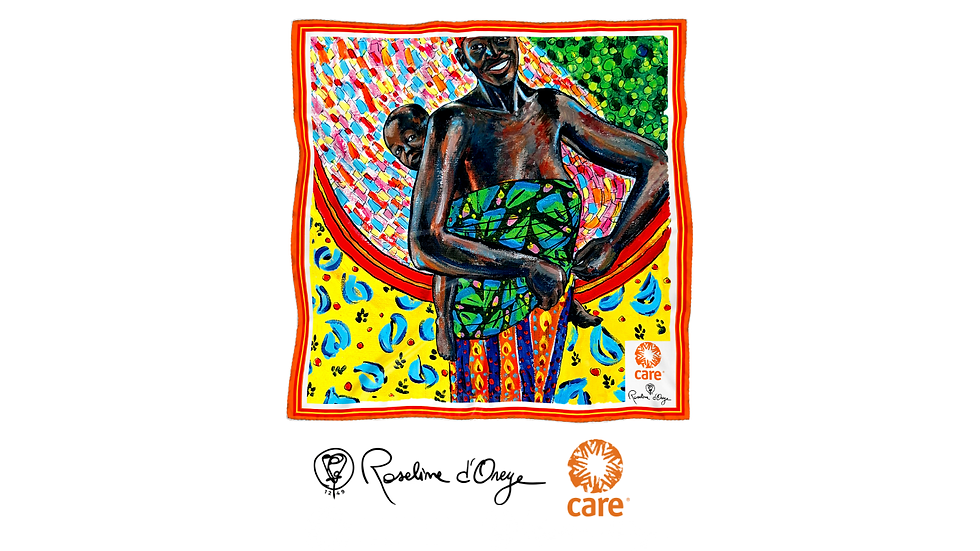
CLIMATE CHANGE IS SEXIST 3.0: Third edition of our call to action
On October 6, 2026, CARE Belgium held the third edition of its advocacy event “CLIMATE CHANGE IS SEXIST” at Flagey in Brussels. A few weeks before COP31 opens in Antalya, Türkiye, the conference brought together researchers, practitioners, policymakers and activists around two questions: why does climate change hit women and girls harder, and how can we build on the solutions women are already driving on the frontlines?
The evening was moderated by Lizan Nijkrake, strategist and journalist working at the intersection of social justice, coloniality and democracy. It opened with a presentation of CARE’s mission and of the campaign by Princess Esmeralda of Belgium, honorary president of CARE Belgium, who framed the link between climate and gender as a lasting question of social justice, not a passing trend. Two panels followed. The first, welcomed Lore Van Praag (Erasmus University Rotterdam), Nidhi Nagabhatla (UNU-CRIS), Sandrine Bohan Jacquot (Humanity & Inclusion) and Thaline Karajá, Indigenous activist and singer from Brazil. The second featured Monica Ellena (CARE International), Hélène Lambert (Enabel) and Ans Persoons, Secretary of State of the Brussels-Capital Region.
The problem: vulnerability is produced, not inherent
The numbers already paint a stark picture. The UN estimates that around 80% of people displaced by climate change are women , and women make up to 43% of the agricultural workforce in developing countries, often without land ownership, access to credit or training in climate-resilient practices .

Monica Ellena unpacked the provocation behind the campaign: vulnerability is not inherent to being a woman, it is produced by unequal social, economic and political structures. The speakers showed how this plays out in very different contexts.

In an oasis village in southeastern Morocco, Lore Van Praag’s research shows that older women who work the land, gather wood and care for the animals are the ones best able to describe how the environment is changing. Yet as climate impacts grow, they lose income and become more dependent on their husbands. Climate change rearranges household roles and reinforces existing inequalities, while women’s knowledge is still rarely counted as expertise.
In Niger, a gender analysis carried out by Enabel for the new Belgium–Niger cooperation programme, presented by Hélène Lambert, points the same way. As water and firewood become scarcer, women and girls lose time for income and school, and women are often left out of early-warning channels. The gap in access to land says it all: 96% of men can access land through inheritance, against 45% of women.
Inequalities also overlap. Sandrine Bohan Jacquot highlighted that persons with disabilities, and girls and women with disabilities in particular, are hit harder by climate hazards, from higher mortality to the loss of assistive devices and essential services. Education suffers too: in Botswana, an estimated 70% of children who drop out of school during periods of drought are girls .

In Brazil, Thaline Karajá described how deforestation, illegal mining and a changing river and forest affect Indigenous communities, and linked these changes to rising mental distress and to violence against Indigenous women and girls. She called for breaking the silence on these issues, with allies who support rather than stigmatise.

Closer to home, Ans Persoons reminded us that Brussels is no exception. Heat stress and air pollution reinforce existing social and spatial inequalities, and women are over-represented in the groups most exposed. In Europe, the heat waves of summer 2022 claimed 56% more female victims . The “neutral city” does not exist, she argued: a feminist approach to climate policy asks not only how we green our cities, but who benefits from that greening, who has access to cooling and who feels safe in public space.

What are the solutions? Women as leaders and knowledge-holders
Women are not only affected, they are at the forefront of solutions. In the Congo Basin, Nidhi Nagabhatla explained, women often manage household water and food, gather forest products and know the seasons and hazards. She made the case for gender-sensitive data in climate governance, and for treating women as leaders and knowledge-holders in adaptation, not only as vulnerable groups.
Monica Ellena showed, with examples from CARE projects around the world, that women lead climate resilience when they have access to finance, training and resources. CARE’s Village Savings and Loan Associations (VSLAs) are a case in point: more than a savings mechanism, they give women control over resources and a say in decisions at home and in their communities.
Concrete initiatives were also shared. In Senegal, women’s groups build improved cookstoves from local materials. In Mozambique, a joint husband-and-wife signature makes women co-owners of solar irrigation equipment. In Peru, the “Guardians of Change” project brings together schools, organisations of persons with disabilities and municipalities to build inclusive climate resilience.

Key takeaways
Across both panels, a few messages came back again and again:
Climate change amplifies inequalities that already exist, and does so differently depending on context, age, disability, income and ethnicity.
Women are at the forefront of solutions, and their knowledge needs to be recognised and funded.
No single action is enough: access to resources, skills and confidence has to go hand in hand with changing the social norms and rules that decide who owns, decides and benefits.
As COP31 approaches, CARE Belgium calls on decision-makers to put women and girls, and their leadership, at the centre of climate action.
We warmly thank our moderator, our speakers, Educaid and everyone who joined us at Flagey for taking part in this important conversation.